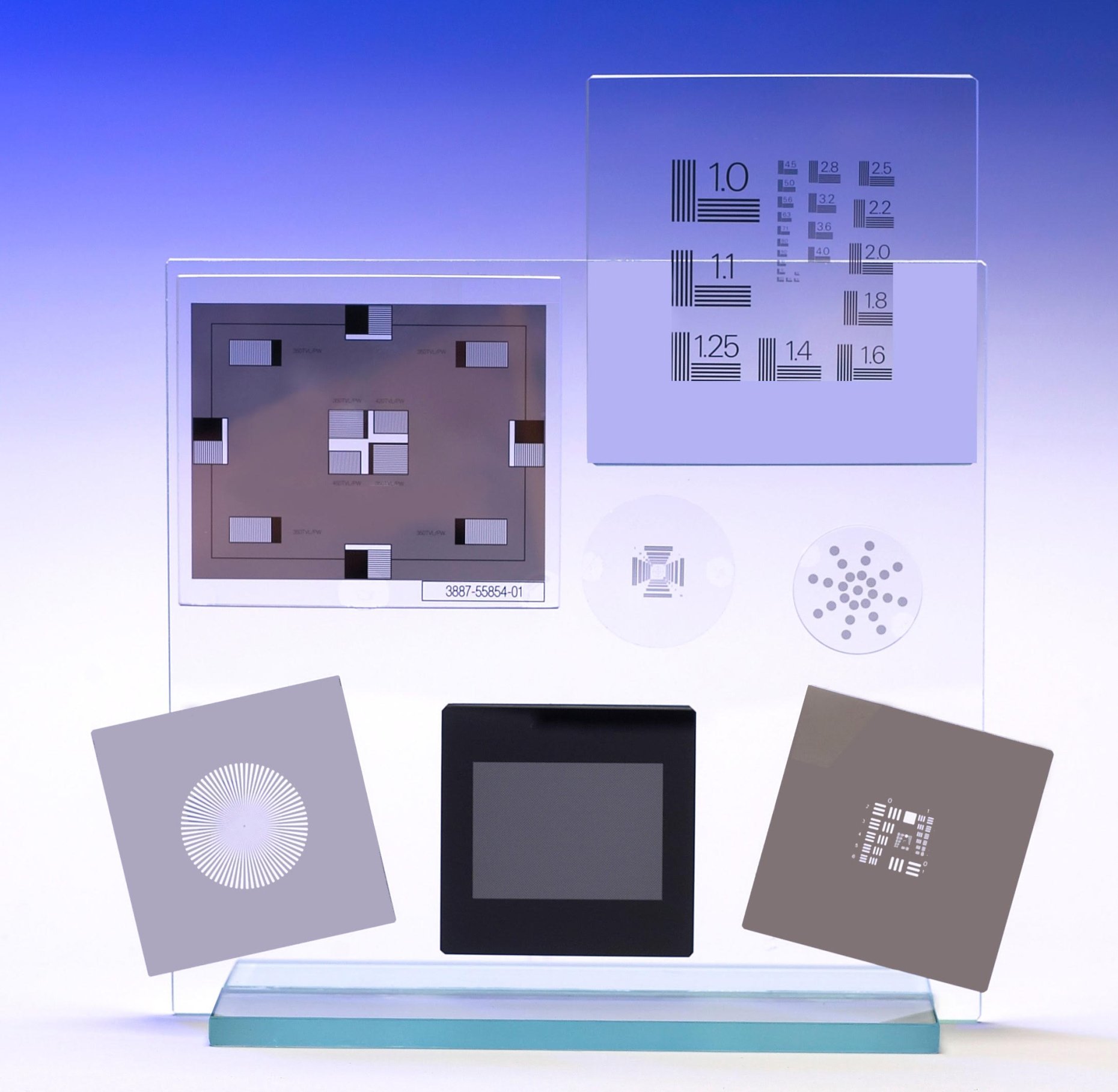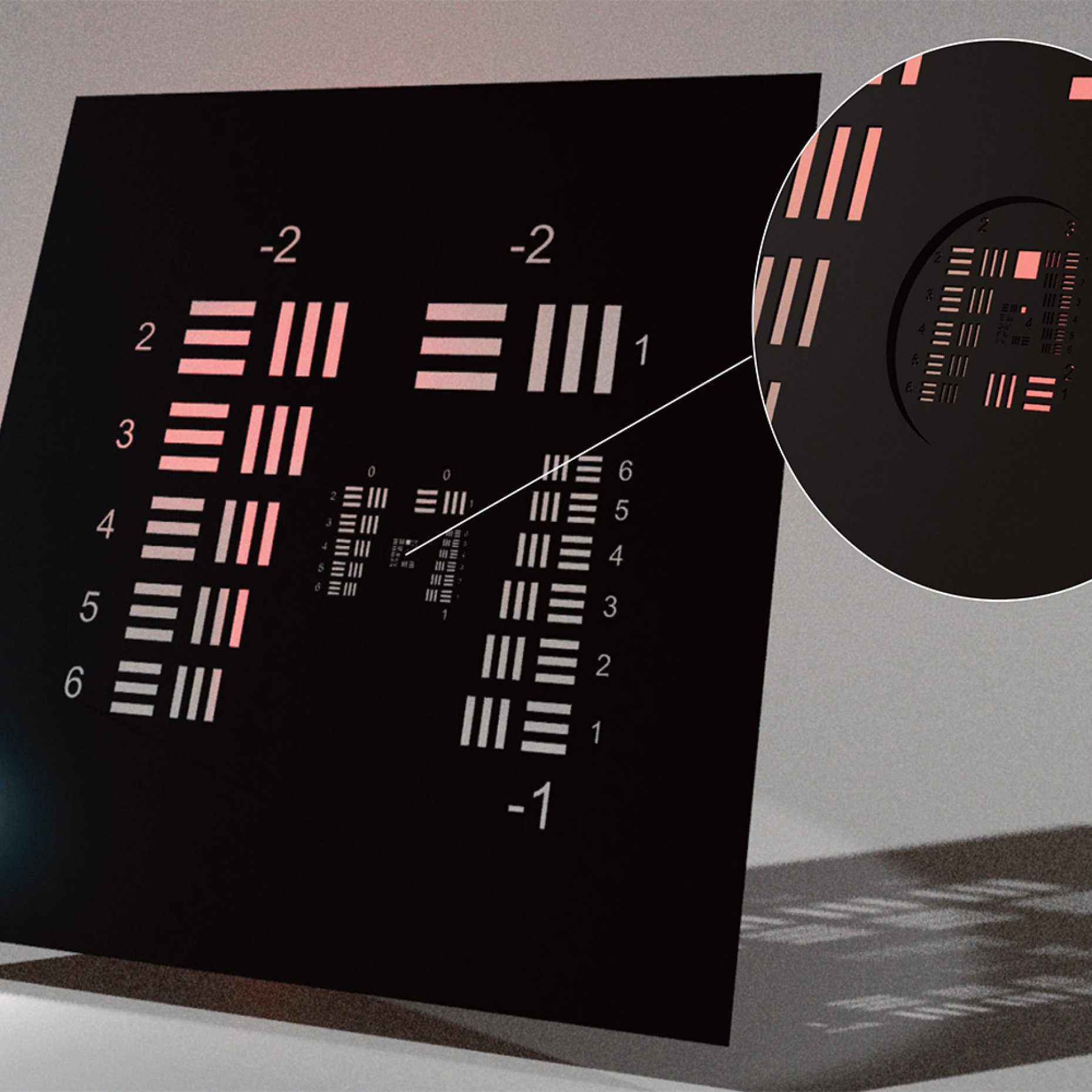

Resolution Slides (Targets)
Optical resolution testing assesses an imaging system’s ability to distinguish fine details by using standardized test patterns, such as USAF-1951 resolution charts with progressively smaller lines and spaces. These tests measure resolving power—commonly expressed in cycles per millimetre (cy/mm) or line pairs per millimetre lp/mm - and help identify performance limitations, including reduced contrast, distortion, and Modulation Transfer Function (MTF) characteristics. Resolution testing is essential for maintaining performance and quality in cameras, microscopes, and other optical instruments. Common approaches include reverse projection and slanted-edge MTF analysis to determine the smallest detail an optical system can reliably resolve.
Key Components and Concepts
- Resolution Targets: Test charts containing patterns such as bars, wedges, or circles that decrease in size (e.g., USAF-1951 charts), used to determine the resolution limit of an optical system.
- Cycles per Millimetre (cy/mm) or Line Pair per Millimetre (lp/mm): A standard unit of spatial resolution, where one cycle consists of one dark bar and one light space.
- Modulation Transfer Function (MTF): A quantitative measure of how contrast is transferred at different spatial frequencies, providing a detailed assessment of image quality.
- Star Targets: Circular patterns of radially converging lines used to evaluate resolution uniformly across the field of view.
Common Testing Methods
- Resolution Chart Analysis: Imaging or viewing a resolution target to identify the smallest distinguishable feature.
- Reverse Projection: Projecting a test target through the optical system onto a screen for rapid qualitative evaluation.
- MTF Testing: Measuring system response to a point or edge input to generate detailed performance curves, offering the most comprehensive analysis.
- Slanted-Edge Testing: Calculating MTF from a slightly angled edge, a widely used and efficient technique for digital imaging systems.
Performance Characteristics Evaluated
- Resolution: The finest level of detail the system can resolve.
- Contrast: The ability to differentiate between light and dark features.
- Distortion: Deviations of the image geometry from the original object.
- Field Performance: Changes in resolution and image quality from the centre to the edges of the field of view.
The complete range of Resolution Slides are shown by clicking this link